Article Overview and Content
In 2026, LSR overmolding is moving beyond its origins as a consumer-electronics waterproofing feature into mainstream structural solutions across automotive, medical and industrial applications. This article reviews three demand drivers — EV and energy storage, medical devices, and consumer electronics — alongside the evolution of liquid injection molding (LIM) and multi-material overmolding, and offers a sourcing checklist for buyers.
If you have handled a mid-to-high-end smartphone, a smartwatch, or an EV component in the past few years, you have probably already touched liquid silicone rubber (LSR) — it was simply hidden inside the housing.
In 2026, this material is shifting from a consumer-electronics waterproofing feature into a mainstream structural solution across automotive, medical and industrial applications. Behind that shift are three demand drivers moving in the same direction, plus two key advances on the process side.
Driver 1: Electric Vehicles and Energy Storage — Sealing and Insulation as Hard Requirements
The first engineering problem electrification creates is protection.
Battery packs, connectors, high-voltage harnesses, onboard sensors and control units must all maintain sealing and insulation over years of vibration, thermal cycling and humidity. LSR offers a wide service-temperature range, low compression set and stable dielectric performance, which is why it is a common elastomer choice for these locations.
The industry-wide observation is consistent: rising EV production is directly pulling LSR volumes into battery sealing applications. At the same time, the expansion of energy storage systems (ESS) and charging infrastructure is creating a second growth market for the same class of seals.
For injection molders, this changes the order mix — moving away from standalone consumer-electronics parts toward integrated "housing + seal + overmold" delivery.
Driver 2: Medical Devices — Biocompatibility and Integrated Assembly
Demand for LSR from the medical device sector has been rising steadily for two reasons.
The first is the material itself. LSR is a two-component, platinum-cured elastomer with good biocompatibility and chemical inertness. It withstands routine disinfection and sterilization processes, which suits the demanding requirements of medical environments.
The second is a structural trend. Medical devices are becoming smaller and more integrated. The traditional route — mold the seal separately, then assemble it by hand — carries higher risk of assembly defects and adds process steps. Integrated overmolding, in which silicone is bonded directly onto a rigid plastic or metal substrate, reduces assembly steps and potential failure points, and is becoming the industry's mainstream technical route.
Medical consumables, diagnostic equipment seals and wearable monitoring devices are currently the three most concentrated demand areas.
Driver 3: Consumer Electronics and Wearables — Waterproofing Meets Miniaturization
Water resistance has long since moved from flagship phones down to mid-to-high-end product lines, and has extended further into smartwatches, TWS earbuds, drones and outdoor electronics.
Unlike the smartphone era, however, consumer electronics in 2026 place two tougher demands on LSR: smaller structures and higher precision. When the seal itself is only millimeters in size, mold precision, feeding-system stability and demolding process together determine yield. That is why the barrier to entry in LSR sits largely in tooling and process rather than in the material.
Two Key Advances on the Process Side
1) Liquid injection molding (LIM) continues to mature
Advances in LIM are shortening cycle times and making complex geometries viable in high-volume production. Combined with automated feeding and metering systems, dimensional stability and batch-to-batch consistency are markedly better than with earlier processes.
2) Two-shot and multi-material overmolding have become baseline capabilities
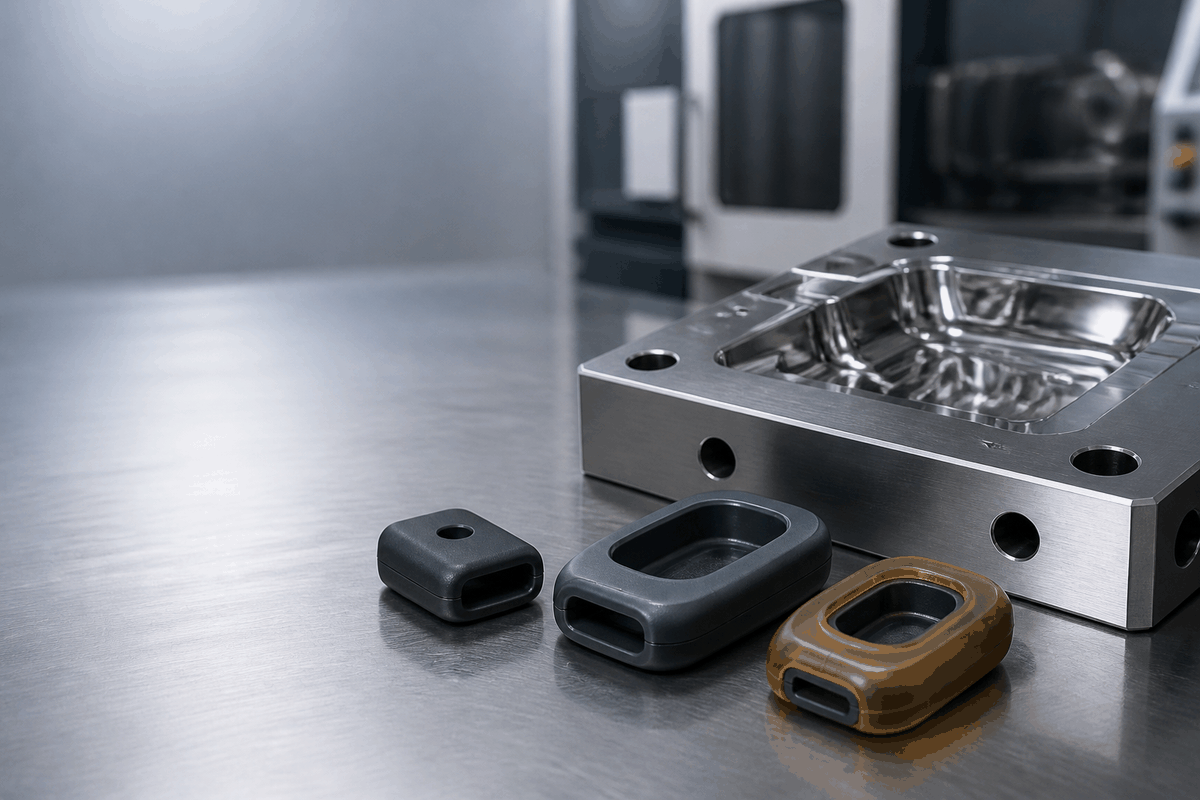
Pure "silicone part" inquiries are declining. What customers want are silicone-on-rigid structural components — for example LSR overmolded onto PC, ABS or nylon substrates to combine soft-touch feel, sealing and structural integrity in one part. This means a molder needs:
Precision mold design and manufacturing capability (including 2K and overmold tooling)
Coordination between two molding processes — rigid plastic and liquid silicone
Experience overmolding onto other substrates such as metal inserts and textiles
Suppliers who can complete all of the above within a single system gain a clear advantage in lead time and quality consistency.
A Buyer's Checklist for Evaluating LSR Overmolding Suppliers
Check item Why it matters
Tooling capability (in-house design and build) Tolerance control on 2K and overmold tooling directly drives yield
Material-grade coverage Medical, food-contact, industrial and optical grades map to different compliance systems
Cleanliness and contamination control Medical and food-contact applications impose specific production-environment requirements
Substrate bonding experience LSR bonding solutions differ for PC, ABS, nylon, metal and textiles
Compliance documentation Can they supply FDA, USP Class VI, LFGB, RoHS and REACH documentation as needed
Prototype-to-production integration Reduces cross-supplier communication loss and scale-up deviation
One external variable to keep watching — regulation: The EU's Packaging and Packaging Waste Regulation (PPWR) entered into force on 12 August 2026, introducing specific requirements including limits on per- and polyfluoroalkyl substances (PFAS) for food-contact packaging. For companies that also supply food-contact silicone products, this is a change to factor in at the material-selection stage.
Where Ruibo Plastic Stands
Dongguan Ruibo Plastic Co., Ltd. is located in Changan Town, Dongguan, Guangdong. The company integrates design, R&D, engineering and manufacturing, providing customers with one-stop service from mold making through injection molding.
For LSR and overmolding requirements, its product and process scope covers:
Precision molds and commodity molds
Two-shot overmolded injection parts
Liquid silicone rubber (LSR) products
Silicone and silicone rubber parts
Automotive components
New energy (energy storage) structural parts
Power tool housings
3C electronics
Office automation housings
Industrial plastic parts
Medical accessory parts
Products are mainly sold in China, Europe and North America.
In a business like LSR overmolding — where tooling, process and material are tightly coupled — Ruibo's value lies in completing mold design and manufacturing and injection molding within one system, reducing the cost and risk customers face when coordinating across multiple suppliers.
Conclusion
The upward demand for LSR overmolding in 2026 is not fundamentally a materials-substitution story. It is the result of rising product structural complexity: devices are smaller, functions are more integrated, and operating environments are harsher — so integrated overmolding has moved from optional to essential.
For buyers, the criteria for choosing a supplier are shifting too — no longer just unit price, but whether a supplier can deliver certainty in tooling, process and compliance documentation at the same time.
About Dongguan Ruibo Plastic Co., Ltd.
Ruibo Plastic provides R&D and production services for precision injection molded and overmolded products, covering two-shot overmolded parts, liquid silicone rubber (LSR) parts, precision molds and commodity molds. Products serve automotive, new energy and energy storage, power tools, 3C electronics, office equipment and medical applications, and are mainly sold in China, Europe and North America.
📩 Business inquiries: kenny@topace-overmold.com 🌐 Website: www.ruiboco.com